
LLM orchestration
Structured prompts, tool calls, validation, fallback behavior, and business-rule enforcement.
The stack combines retrieval, multimodal indexing, workflow orchestration, observability, and deployment-aware engineering.
Structured prompts, tool calls, validation, fallback behavior, and business-rule enforcement.
Semantic search over documents, transcripts, metadata, archive assets, and operational knowledge.
Speech, visual, scene, object, person, and metadata signals combined into searchable media context.
Queue-based jobs, approvals, review states, notifications, and system-to-system automation.
Logs, audit trails, evaluations, model outputs, approval history, and operational dashboards.
Cloud, customer VPC, hybrid, and on-prem connected environments depending on the workflow and data policy.
Context is gathered through indexing and retrieval, reasoning happens through orchestrated LLM calls, and action is executed through the workflow layer — with observability tracking every step and deployment models providing the operating substrate.
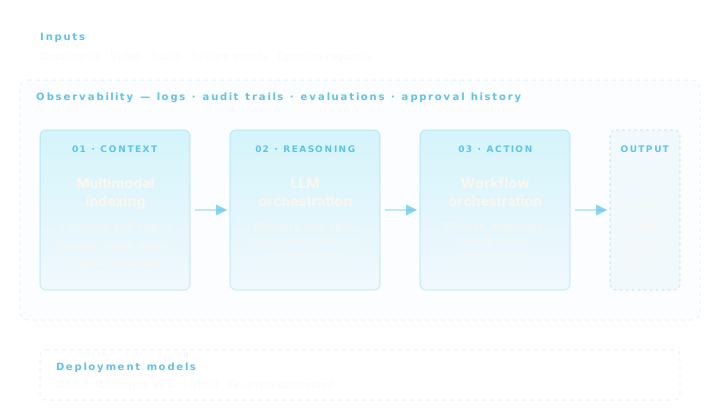
For production environments, the system must show what it did, why it did it, which source data it used, who approved the result, and how to correct it. That is the difference between a demo and an operating system.
We can help translate a business workflow into a deployment-ready technical design.